
NVIDIA GeForce RTX 3090 Ti GPU Unlock: Nearly 80% Compute Boost Explained
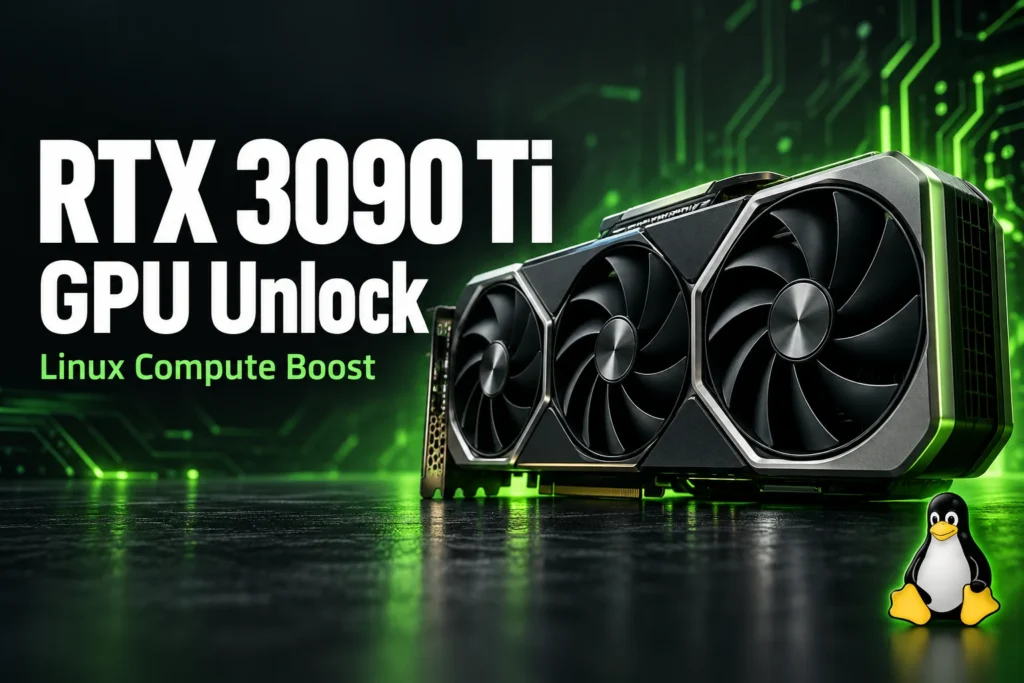
A graphics card getting faster without a hardware upgrade sounds like something every PC owner would welcome. That is why the NVIDIA GeForce RTX 3090 Ti is attracting attention following community tests of an open-source project called GPU Unlock.
The headline result is impressive: one published benchmark shows BF16 compute throughput increasing by approximately 80%. However, that figure needs context. It measures a particular calculation workload, so readers should not interpret it as an equivalent improvement across games, creative applications, or every AI task.
Here is what the project does, what the results actually show, and how to judge whether the development matters for your workload.
Why the NVIDIA GeForce RTX 3090 Ti Still Attracts Interest
The RTX 3090 Ti belongs to NVIDIA’s Ampere generation and features 10,752 CUDA cores alongside 24GB of GDDR6X memory. NVIDIA positioned the RTX 3090 family for demanding gaming and creative workloads.
For someone who already owns this card, the practical question is straightforward: can existing hardware finish useful work faster?
That is a different question from whether an older graphics card beats a newer model. An optimisation can be valuable without changing the overall ranking of GPU generations. The relevant comparison is the same system completing the same task before and after the change.
What Is GPU Unlock?
GPU Unlock is a community-developed Linux kernel module targeting certain NVIDIA Ampere GPUs. Its documentation describes changes to instruction issue rates for FP16 and BF16 calculations that accumulate results in FP32.
In simpler terms, it targets how quickly supported hardware can process particular mathematical operations.
The current project documentation says the module runs before the NVIDIA driver takes control of the card. It also explicitly states that the approach does not require a patched NVIDIA driver. That detail matters when reading older explanations of how the project works.
This is a specialised compute modification. Its value depends on whether the applications you run spend meaningful time performing the affected calculations.
RTX 3090 Ti Performance Boost: What the Benchmarks Show
A published RTX 3090 Ti test reports the following results for dense matrix multiplication at a 450W power limit:
| Calculation format | Before unlocking | After unlocking | Approximate improvement |
|---|---|---|---|
| FP16 | 87.46 TFLOPS | 118.39 TFLOPS | 35% |
| BF16 | 87.50 TFLOPS | 157.41 TFLOPS | 80% |
| TF32 | 42.58 TFLOPS | 82.61 TFLOPS | 94% |
The report describes five-sample median measurements using FP32 accumulation. These are community-published results rather than benchmarks performed for this article.
Notice that the improvement varies substantially between formats. Even within one test setup, there is no single percentage that accurately describes every operation.
The useful headline is therefore specific: a substantial increase in measured compute throughput under particular conditions.
What Do FP16, BF16, and TF32 Mean?
These terms describe numerical formats used in GPU calculations. Different formats balance precision, numerical range, and processing efficiency.
For readers evaluating benchmarks, the important point is consistency. A result using one format should not be treated as interchangeable with a result using another.
The same applies to accumulation, which describes how intermediate results are combined. When comparing two benchmark numbers, check that the input format, accumulation method, and workload match.
Otherwise, an apparently dramatic improvement may reflect differences in testing rather than the change being evaluated.
Could GPU Unlock Make AI Applications Faster?
The project documentation reports improvements in matrix-heavy workloads, including parts of large language model processing. It summarises community reports showing approximately 14% to 36% faster LLM prefill.
Prefill is the stage where a model processes the input prompt before generating its response. The documentation also says memory-bandwidth-limited decoding and INT8 work remain largely unchanged.
For an AI user, this means the experience could improve unevenly. A model might begin responding sooner while producing subsequent text at a similar speed.
That distinction makes application-level testing essential. A faster calculation is useful, but the result most people care about is how long their actual task takes.
Does This Mean an 80% Gaming Performance Increase?
The cited benchmark does not establish an 80% increase in gaming frame rates. It measures matrix multiplication throughput. Games involve many interacting workloads, and a compute benchmark alone cannot tell you how a particular title will perform.
If you mainly use your NVIDIA GeForce RTX 3090 Ti for gaming, look for direct comparisons showing average FPS, frame-time behaviour, and identical graphics settings. Until those measurements are available, the compute result should remain a compute result.
The same reasoning applies to video editing and rendering. Each application needs evidence relevant to its own workload.
What Should Owners Check Before Testing?
Treat an RTX 3090 Ti GPU Unlock experiment as a measured comparison. A useful test plan includes:
- Recording application performance before making changes.
- Keeping power limits and software settings consistent.
- Repeating tests to identify normal variation.
- Checking output quality and correctness.
- Measuring complete task duration alongside benchmark throughput.
Decide what success means before starting. For one user, it might be shorter prompt-processing time. For another, it could be completing a batch of calculations sooner. A higher benchmark score matters most when it supports that practical goal.
How Should You Interpret Community Results?
Community testing can reveal promising behaviour, but individual reports have limits. Ask whether a result includes enough detail to reproduce it. Hardware configuration, software versions, power settings, and the exact task all help explain what was measured. Also distinguish a successful launch from sustained reliability. An application starting correctly does not establish that it will complete a long workload accurately.
The strongest evidence combines repeatable speed measurements with consistent outputs and successful completion of representative tasks.
Is GPU Unlock Worth Watching?
For owners running relevant compute workloads, GPU Unlock is a development worth following. The reported gains justify further testing, particularly where the affected operations occupy a large share of execution time.
For everyone else, the best approach is to match the evidence to the intended use.
The RTX 3090 Ti performance boost story is compelling because it raises the possibility of getting more useful work from existing hardware. Its real value will be determined by repeatable application results, rather than one percentage applied to every task.